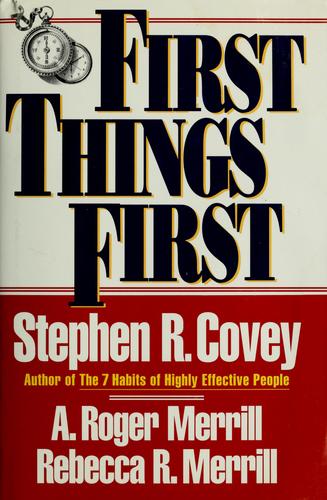
 | Important beats urgent when the week is run from roles and mission — not from the loudest inbox. Covey popularised the four-quadrant grid; the book’s weight is principle-centred scheduling: compass before clock. Stephen R. Covey, A. Roger Merrill, & Rebecca R. Merrill First published 1994 - Reprint (1996) · Free Press · ISBN 9780684802039 |
|---|
Key principles
- Important vs urgent — Eisenhower-style triage — urgency screams; importance whispers — neglect quadrant two, strategy dies.
- Roles before tasks — Organize the week around roles and mission, not only inbox volume — calendar reflects identity.
- Clock and compass — Schedule is clock; mission is compass — efficiency in wrong direction is waste at speed.
- Quadrant two — Prevention, relationships, and capability building are rarely urgent — protect them with explicit blocks.
- Weekly planning — Connect goals to time boxes — intention without allocation is wish.
- Principle-centred living — Big rocks first — values and roles set the frame before tasks fill the gaps.
Core science
Extends Covey’s principle-centred frame from The 7 Habits into time stewardship — the urgent/important matrix as a repeatable lens on attention allocation, not a one-off poster.
Application
Use when members live in quadrant one firefighting or confuse busy with strategic — assign the matrix as vocabulary; operational weekly moves stay in doctrine and Battles. Open Eisenhower Matrix on the Atlas shelf for the mechanism map. Curated domain trail: Productivity.