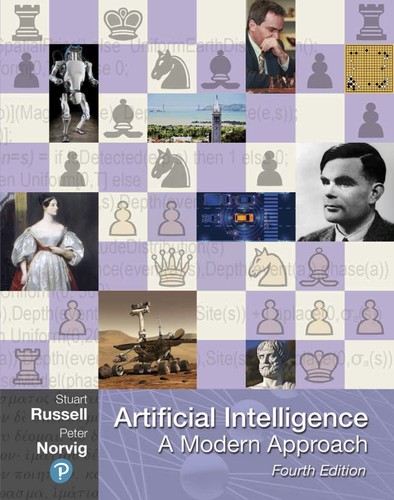
 | Russell and Norvig frame intelligent agents as entities that sense, decide, and act — search, logic, probability, and learning are engineering levers on the same rational-action problem, not separate magic domains. Russell First published 1995 - Edition (2009) · Prentice Hall · ISBN 9780136042594 |
|---|
Key principles
- Rational-agent design — Goals, environment model, and action policy — agent quality is measured by outcomes under constraints, not rhetoric.
- Search architecture — State-space exploration with informed heuristics — combinatorial problems yield to structure when representation is honest.
- Logic and knowledge — Propositional and first-order layers for explicit belief — transparency trades flexibility for auditability.
- Probabilistic reasoning — Uncertainty as degree of belief, not ignorance excuse — decision theory unifies evidence under noise.
- Machine learning loop — Generalization from data with explicit bias–variance trade-offs — learning complements hand-coded knowledge instead of replacing craft.
- Multi-agent environment — Other agents change the world model — coordination and negotiation belong in the same textbook spine.
Core science
Artificial Intelligence: A Modern Approach is the canonical undergraduate–graduate spine for the field — integrating classical AI (search, planning, logic) with modern statistical learning and decision under uncertainty. Wooldridge’s multiagent systems volume adds coordination depth; on the Codex shelf pair with Agent orchestration for workflow design, not only algorithm trivia.
Application
Reach for this volume when agent design, rational-action framing, or teachable AI vocabulary needs a textbook anchor — before tool-chasing without shared representation. Open Agent orchestration on the Atlas shelf for the mechanism map.