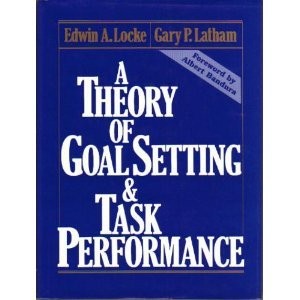
 | Locke and Latham assemble the goal-setting spine: specific challenging goals, commitment, and feedback beat “do your best.” The volume is the long-form theory book behind the later APA synthesis — useful when Remontada or Dream 100 needs a named score, not ambient effort. Locke, E. A., & Latham, G. P. (1990) · Prentice Hall · ISBN 9780132479745 |
|---|
Key principles
- Specific-challenging goals — Concrete hard targets outperform vague exhortation when ability fits the task.
- Commitment moderates stretch — Hard goals only lift performance when the person owns the target.
- Feedback closes the loop — Goals without knowledge of results decay into slogans.
- Task-complexity boundary — On complex tasks, learning and strategy mediate — not raw goal intensity alone.
- Do-your-best underperforms — Ambient effort language loses to a named standard with a score.
- Mechanisms of direction — Goals direct attention, effort, persistence, and strategy search — four paths, not one pep talk.
Core science
Goal-setting theory is one of the most replicated motivation frameworks in organisational psychology. This 1990 volume consolidates experimental and field evidence that later appears in condensed form in Locke & Latham’s 2002 American Psychologist synthesis (Locke 2002). Treat as the book spine; the 2002 article as the short cite.
Application
Open when a Remontada lag is still a mood (“try harder”) instead of a named score — or when a Dream 100 list needs the science of why specific targets beat spray ambition. Pair with La Remontada and Dream 100 of ideal clients.